
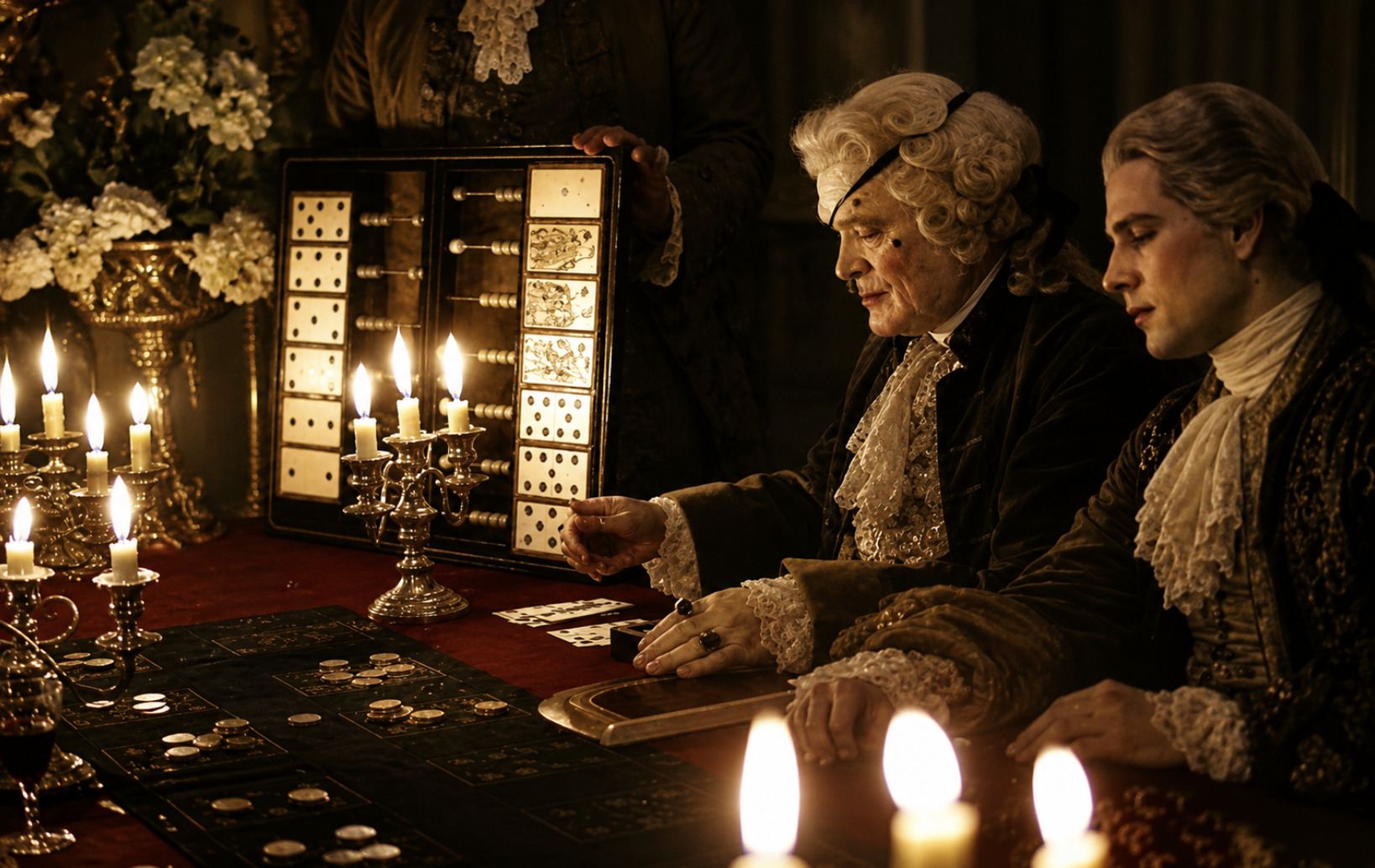
Among the many pastimes that filled the long hours of court life, none carried quite the symbolic weight of a pair of dice. Playing cards, when they arrived in Europe in the late fourteenth century, would in time become the great obsession of salons and gaming tables. But dice were there first, by thousands of years, and they held a place in the imagination of the European aristocracy that cards, for all their popularity, never fully displaced. To the noble mind, dice were not merely a game. They were a small, rattling emblem of the three things a great family was supposed to command: status, fate, and power.
The oldest game of all
Part of the appeal was sheer antiquity. Dice are among the most ancient instruments of play known to humanity, carved from bone and stone and rolled across the floors of empires long before Europe had a nobility to speak of. By the time cards appeared, dice already carried the prestige of the classical world — the games of Romans and emperors, of soldiers and senators. For an aristocracy that defined itself by lineage and inheritance, this mattered. Dice had a pedigree. They were the game of antiquity, and to play them was to participate in something old and noble rather than something newly fashionable.
Cards, by contrast, were a recent import, and their early reputation was tangled up with merchants, gamblers, and the rising commercial classes. Dice belonged to a deeper, grander past, and the nobility has always preferred the things that flatter its sense of continuity with a glorious history.
A direct conversation with fate
The deeper reason dice held the aristocratic imagination, though, was philosophical. A throw of the dice is pure chance — there is no concealment, no calculation, no skill that can bend the outcome. The dice leave the hand and the result belongs entirely to fortune. For a class steeped in the imagery of the Wheel of Fortune, that capricious goddess who raised men up and cast them down without reason, dice were the most honest possible encounter with fate itself. To roll them was to stand, openly and without defence, before destiny.
This appealed enormously to the aristocratic self-image. The nobleman was meant to face fortune with courage, to accept what fate decreed without flinching, to wager boldly and lose gracefully. Cards, with their hidden hands and clever play, invited scheming, bluffing, and the slow accumulation of small advantages — virtues, perhaps, but mercantile ones, the qualities of a careful trader rather than a fearless lord. Dice asked for nothing but nerve. They were a game of fate confronted head-on, and the willingness to submit to chance was, in the courtly code, a mark of nobility. There is a reason the most famous phrase about dice in all of Western history belongs to a man crossing a river to seize power: the die, Caesar is said to have declared, is cast. Dice were the language of decisive, irreversible fate, and that language suited those who believed themselves born to command it.
The theatre of status
If fate was the philosophy of dice, status was their performance. High-stakes dicing was one of the great social theatres of the court, a stage on which an aristocrat could display exactly the qualities his rank demanded. To wager a fortune on a single throw, and to do it with apparent indifference, was a spectacular demonstration of wealth and of the lordly disregard for money that wealth was supposed to confer. The point was never to win — winning was almost vulgar — but to show that one could afford to lose magnificently and remain unmoved.
This made the gaming table a stage for the aristocratic ideal of effortless grace under pressure. A nobleman who could lose an estate's worth of gold on the roll of the dice and rise from the table with a smile had proven something money alone could not buy: that he was above money, ruled by honour rather than prudence. Gambling debts at court became debts of honour, more sacred than ordinary obligations precisely because they had no legal force — they rested entirely on a gentleman's word. To play dice for high stakes was to put one's status, nerve, and honour on display all at once, in a single dramatic gesture that everyone present understood.
The privilege of risk
There was also a quieter dimension of power in all this. The freedom to gamble recklessly was itself a privilege, a luxury available only to those for whom ruin was survivable or, better still, unthinkable. When a commoner gambled, it was a vice, a road to the gutter, and rulers issued laws against it. When an aristocrat gambled, it was a pastime, an expression of liberty and standing. The same act carried opposite meanings depending on who performed it, and that asymmetry was the whole point. To risk a fortune lightly was to advertise that one possessed a fortune in the first place, and a position secure enough to treat it as a plaything.
Of course, this courted disaster, and disaster duly came. Great families bled themselves dry at the dicing table, fortunes built over generations vanished in a night, and monarchs periodically tried to ban or restrain the gaming that was hollowing out their nobility. The moralists thundered; the debts mounted; the dice kept rolling. The very recklessness that made dicing such a perfect emblem of aristocratic status was also what made it so ruinous, and the history of the European nobility is dotted with houses that gambled themselves into oblivion.
The roll that never stopped
In time, cards and ever more refined games of chance came to dominate the elegant gaming rooms, and dice slowly lost their central place. But the meanings they carried never quite died. The fascination they embodied — the thrill of submitting to pure fortune, the drama of the single decisive throw, the small object that holds status, fate, and power in its tumbling fall — proved far more durable than any single age or class. That ancient thrill survives wherever people still gather around the promise of the roll, from the historic salons of Europe to modern digital venues such as Dicepalace Casino, where the same elemental encounter with chance is dressed in contemporary form.
What the aristocrats understood, and what gives their love of dice its lasting fascination, is that the game was never really about the money. It was about standing before fortune and daring her to decide. The dice were small, but they held something vast: a way of staging, in a single throw, the oldest human drama of all — the confrontation between a person and their fate. The courts have vanished and the fortunes have scattered, but the rattle of the dice still carries that ancient charge, and we still, after all these centuries, lean in to watch them fall.