
On a winter evening in 1638, in a wing of the Palazzo Dandolo near the church of San Moisè in Venice, a set of doors was opened that would, in a quiet and almost bureaucratic way, change the cultural history of Europe. Behind those doors was a room the Venetian Republic had decided to legalise rather than prohibit — a public gambling house, run under the supervision of the Council of Ten, in which any masked patrician could place a wager on cards and dice within the four walls of the city's own architectural prestige. It was called the Ridotto, from the Italian ridotto, the diminutive of ridurre — a place to retreat to. It is conventionally remembered as the first government-sanctioned casino in the modern sense. What it actually was, and what it inaugurated, is something larger.
Long before the word casino meant a glass-and-neon resort on a desert strip, or a tab open on a phone in a pocket, gambling in Europe was a thing that aristocrats did inside the buildings their wealth had already produced for other purposes. It happened in palaces because palaces were where life happened. It happened with rituals and costumes because the rest of life happened with rituals and costumes. And it produced, over roughly two and a half centuries, a specific architectural and cultural grammar — what one might fairly call a poetics of risk — whose afterlife shapes online gambling design today in ways most of its users would not recognise but would, on inspection, find unmistakable.
This is the story of how that grammar was built, what it actually meant for the people inside it, and what happened to it when the rooms went away.
The Ridotto and the invention of a public room
The opening of the Ridotto in 1638 is a useful place to start because it was, in legal and architectural terms, the first time a European state took the gambling that had previously happened in private chambers — in princes' apartments, in the back rooms of taverns, in cardinals' salons — and gave it a public address.
The room was a hall in a noble palazzo, with smaller rooms branching off it. The Council of Ten controlled access and operations. Only Venetian patricians, members of the city's hereditary nobility, were permitted to operate the gaming banks — a detail that mattered, because it meant that the house's profits flowed into the same families that already governed the Republic. Everyone else — visiting nobles, foreign diplomats, prosperous merchants, courtesans, anyone who could afford the stake — was permitted to play, but on one absolute condition. They had to wear the mask.
The Venetian bauta, a stark white face covering with a protruding jaw that allowed a wearer to eat and drink without removing it, paired with a black tricorn hat and a dark cloak called a tabarro, was already by 1638 a standard piece of Venetian street wear during much of the year. Inside the Ridotto, the mask became more than a fashion: it was the great equaliser, the device that allowed a senator to lose his fortune to a courtesan and a foreign ambassador to walk away from the table without political consequence. The room dissolved the city's rigid social map for the hours one was inside it, and the architecture of the palazzo — high ceilings, candlelit chandeliers, the rooms unfolding from one another — was the stage on which that dissolution played out.
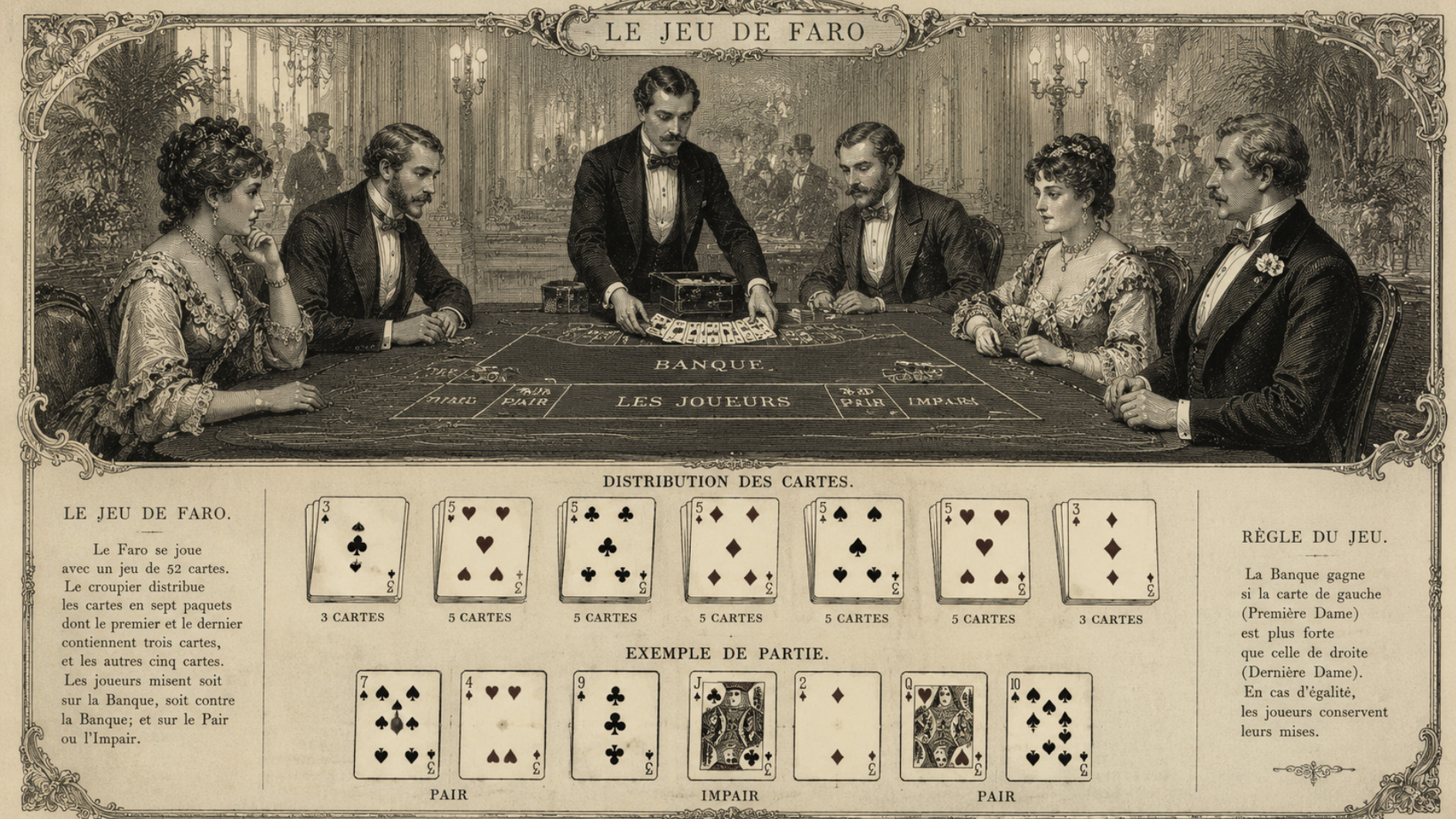
The Ridotto's most popular games were basetta and, later, faro — card games with simple rules and ruinous variance. Faro in particular would propagate through Europe over the next century with the speed of fashion, ending up at every court that aspired to glamour. The Ridotto did not last forever; in 1774, the Great Council closed it under doge Alvise IV Mocenigo on the grounds that it was ruining noble families. The closure barely interrupted Venetian gambling — within a few years, more than a hundred small private gambling rooms had opened across the city, each of them called a casino, the diminutive of casa, "little house." The word survives in every language that came after, but its etymology preserves the original architectural truth: gambling, in Europe, lived in houses before it lived anywhere else.
The grammar of the salon
To understand what the Ridotto inaugurated, it helps to look at the larger institution it sat inside. The European salon of the seventeenth and eighteenth centuries was the principal architectural form of upper-class social life, and gambling was one of its standard activities — alongside conversation, music, supper, the reading of letters, and the careful work of political and amorous alignment that made up the actual business of court life.
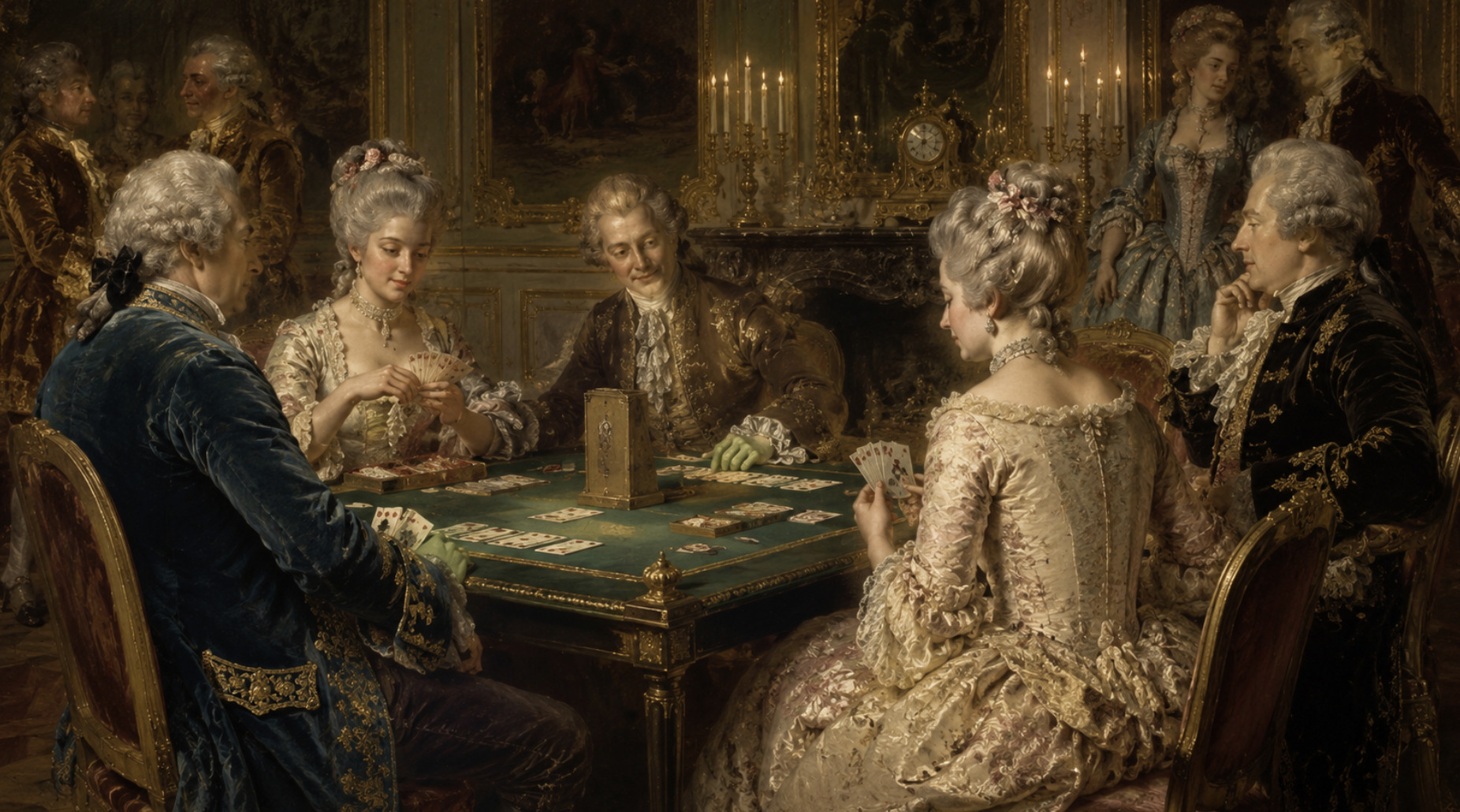
In France, the salon in the strict sense was the room hosted by an aristocratic woman in which intellectual and social life were conducted. Gambling there was rarely the headline event; it was the activity that filled the hours and provided a continuous background to everything else. The games shifted with fashion — basset in the late seventeenth century, quinze, pharaon, lansquenet, biribi through the eighteenth — but the architectural and social logic stayed constant. A small green-baize table at one end of a panelled drawing room, six to eight chairs around it, candles in sconces on the walls, the lacquered black-and-gold of the cabinetwork picked up in the embroidery of the players' coats: the visual signature of the European gambling room as we now imagine it was being assembled here, table by table, room by room, decade by decade.
The French court at Versailles formalised the practice. Louis XIV permitted, and at intervals encouraged, certain card games at court; the jeux du roi were structured occasions in which the king and his guests played in public, observed by the rest of the court arrayed around them. Marie-Antoinette, in the latter part of her reign, became famous for losses at faro that were neither modest nor private — and which, in the years before the Revolution, joined the catalogue of grievances against the monarchy. The room was the architecture of risk, but the risk itself was political as much as financial. Where the king played, the court watched. Where the queen lost, the kingdom heard.
Beyond Versailles, the académie de jeu spread across Paris — formal establishments, half club and half gambling house, in which subscribers played under house rules. The line between the legal and the clandestine was porous; police records of the eighteenth century are thick with the tripots, the unlicensed back-room operations that catered to those without the connections to enter an académie. The salon was the visible top of an iceberg whose lower reaches were not so different in mechanism, only in lighting.
What this entire ecosystem had in common, from the masked Ridotto to the smoky Parisian tripot to the panelled drawing room at a Loire chateau, was the assumption that gambling was a social activity. It happened in the presence of other people. It was witnessed. The other players, the spectators, the servants moving discreetly through the room, the architecture itself — all of these were part of the experience, and most of them were absent from any modern conception of gambling at all.
The spa town and the German Kurhaus
The eighteenth century's preoccupation with health, and specifically with the supposedly medicinal properties of mineral water, produced one of the great accidental innovations in European gambling architecture: the spa town. A traveller who went to take the waters at Spa in the southern Netherlands, or at Aix-la-Chapelle, or at Bad Homburg, or at Wiesbaden, was visiting a place that had assembled itself around the cure — but that needed something to occupy its visitors when they were not standing in the bath house at six in the morning drinking sulphurous water for their digestion. The answer, by the second half of the eighteenth century, was the Kursaal or Redoute: a purpose-built hall, attached to the spa, in which gambling and dancing and music and supper occurred in carefully managed proportions across the long evening.
Spa, in modern Belgium, opened its Redoute in 1763. Aix-la-Chapelle followed. By the early nineteenth century, the German states had become the centre of European gambling on the strength of a handful of these establishments — Bad Homburg, Baden-Baden, Wiesbaden, Ems — each built around a Spielbank, a state-licensed bank of games operated under exclusive concession.
The decisive figures of this period were the brothers François and Louis Blanc, who in 1841 acquired the gambling concession at Bad Homburg and introduced an innovation that would, eventually, define the modern roulette table: the single-zero wheel. The earlier wheels carried both a zero and a double zero — two pockets that belonged to the house — and the Blanc brothers' single-zero version, by reducing the house edge, was an aggressive competitive move against the older Bavarian operations. It worked. Bad Homburg flourished. The Kurhaus, designed by the architect Louis Jacobi and completed in 1843, became one of the most visited buildings in Europe for the better part of three decades.
The architecture of these establishments deserves attention. They were not styled as places of vice. They were styled as places of culture — Neoclassical exteriors, marble floors, double-height halls, concert programs alongside the gaming tables, restaurants run by chefs trained in the great Parisian kitchens. The implicit argument of the architecture was that gambling, here, was part of a larger civic and cultural offering. You came for the waters. You stayed for the orchestra. You drifted to the tables. The line between leisure and risk was, by design, smudged.
That same cultural logic survives today in the way modern casino brands attempt to position themselves not simply as betting products, but as complete entertainment environments with their own aesthetic language, social atmosphere, and rituals of participation. Contemporary platforms like DicePalace borrow heavily from this historical inheritance, presenting gaming not as an isolated act of wagering but as part of a broader digital leisure experience shaped by visual design, interface psychology, and the promise of exclusivity. The technology may have changed completely, but the underlying ambition remains recognisable: to make the movement from entertainment into gambling feel seamless, elegant, and almost inevitable.
That changed in 1872, when Otto von Bismarck — pursuing a moral and political consolidation of the new German Empire — banned commercial gambling across Germany. The Blanc brothers, who had read the political signals well in advance, had already moved. The story of their move is the story of how the European gambling palace became its modern, recognisable form.
Monte-Carlo and the ratification of the form
By the early 1860s, Monaco was a small, financially struggling principality whose ruling house, the Grimaldis, were trying every available expedient to find a source of revenue. Princess Caroline had pushed for a casino through the 1850s; several false starts had failed. In 1863, Prince Charles III granted the gambling concession to a newly formed company controlled by François Blanc — the Société des Bains de Mer et du Cercle des Étrangers de Monaco, a name designed to emphasise the swimming and the social club rather than the tables.
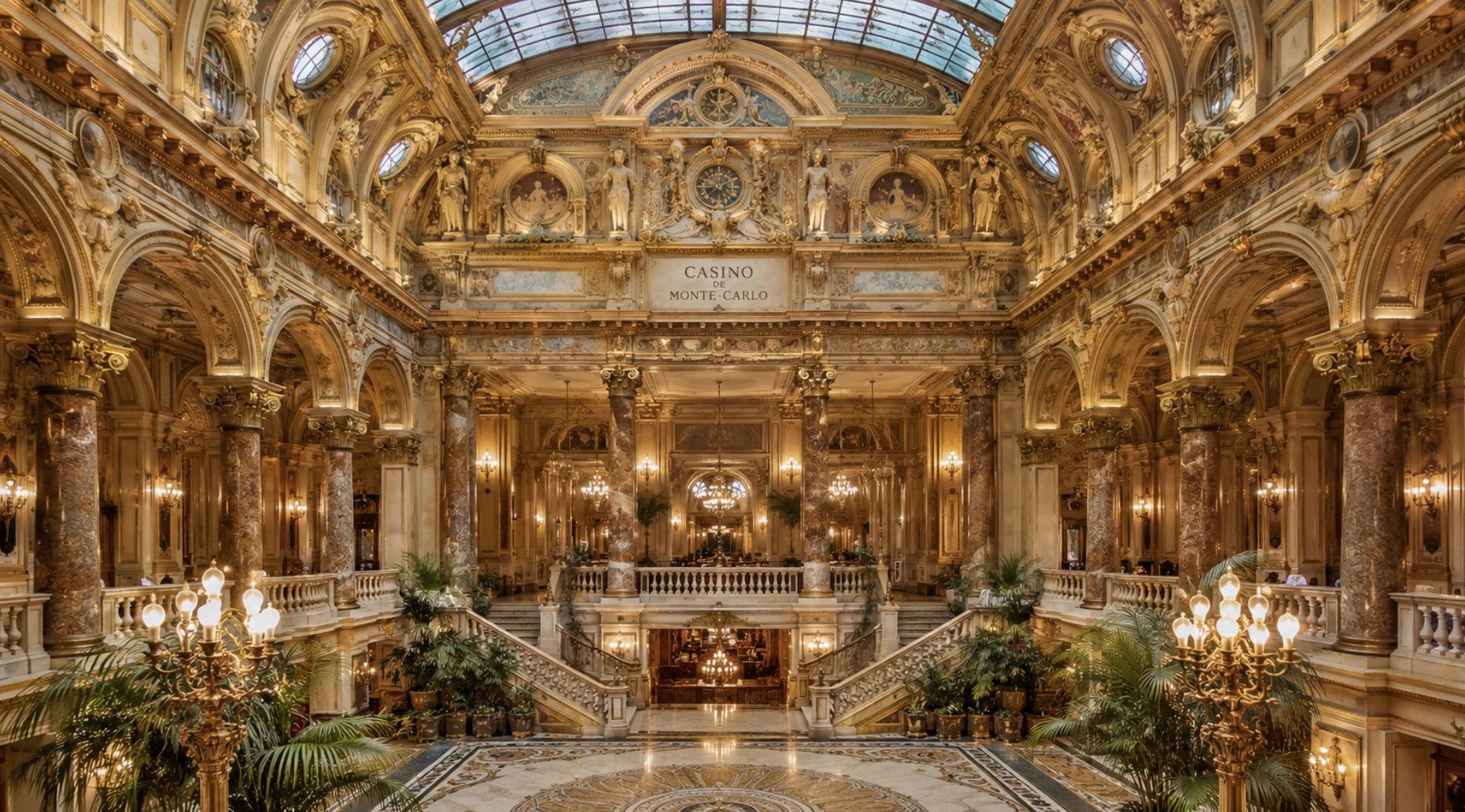
The casino at Monte-Carlo opened in temporary premises and then, in 1878 and 1879, was expanded by Charles Garnier — the architect of the Paris Opera — into the building that now anchors the cultural memory of European gambling. Garnier brought with him the full Beaux-Arts vocabulary of Second Empire Paris: the atrium with its onyx columns, the salons in successive stages of refinement, the Salle Europe with its Bohemian chandeliers, the Salle Garnier built as a literal opera house attached to the gambling rooms, in which Sarah Bernhardt opened the inaugural season. The architectural argument was clear and confident. The casino was not a den. It was a palace, in continuity with the great civic buildings of European capitals, and its risk-taking was, by virtue of that continuity, civilised.
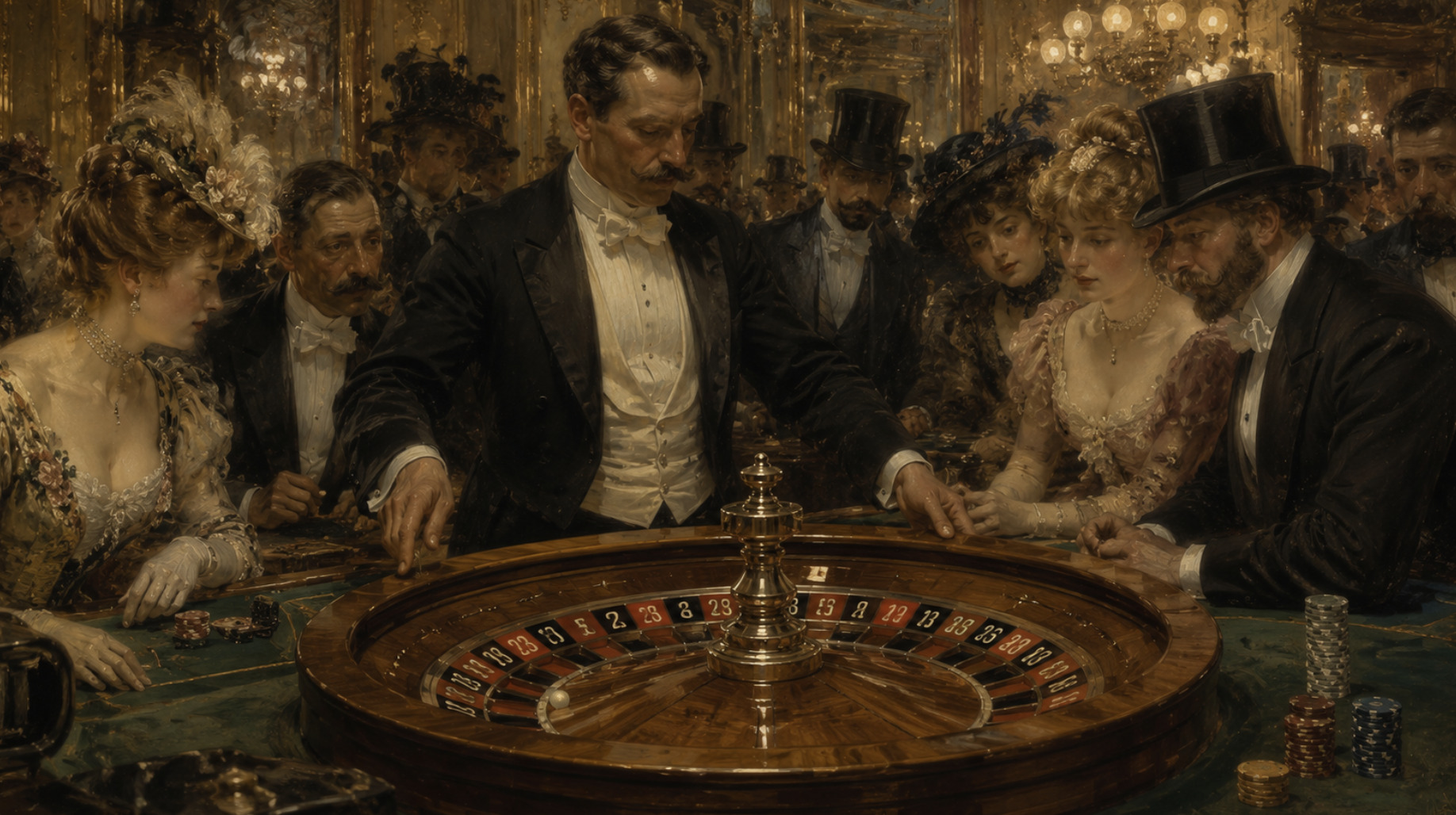
Monte-Carlo also ratified, in a way no previous establishment had, the social codes that had been forming around aristocratic gambling for two and a half centuries. The dress code was strict: evening wear after dark, jacket and tie at minimum during the day. Access to the private salons — the Salons Privés — required separate admission, higher stakes, and the kind of social vouching that the Venetian mask had been designed to make irrelevant. The mask was gone. In its place was the costume, deployed in the opposite direction: to filter and to display rather than to obscure. The bauta had levelled the room. The Monte-Carlo evening dress hierarchised it.
This was the moment European gambling culture reached its final, defining shape. It would persist through the Belle Époque, survive both world wars in a diminished form, and provide the visual template for almost every brick-and-mortar casino that would follow — including, eventually, the Las Vegas Strip, whose great Beaux-Arts pastiches of the 1990s and 2000s are recognisable as Monte-Carlo in costume.
What the palaces were actually doing
Strip away the chandeliers and the etymology and the centuries, and the European gambling palace from the Ridotto to Monte-Carlo was always doing three specific things at once, and the doing of those three things in combination was the whole architecture of the form.
The first was the orchestration of spectacle. The room was designed to be looked at. The materials — velvet, gilt, mirrored walls, chandeliers whose light multiplied on the polished surfaces of the tables — were chosen to produce a particular visual envelope. Gambling inside that envelope felt different from gambling at a kitchen table because the envelope was making an argument about the importance of what was happening. Whether or not the argument was correct, it was felt. The architecture was emotional infrastructure.
The second was the management of witness. Every European gambling palace was structured around the presence of other people. The salon, the public hall, the gallery from which one could watch without playing — all of these meant that any bet placed was placed in front of an audience. The audience included friends, rivals, lovers, creditors, servants, and strangers. The presence of witnesses gave each wager a social weight that the bet itself, considered as a transaction between a player and a house, did not have. Wins were celebrated. Losses were absorbed in front of others. The room enforced a certain dignity, simply by being full.
The third was the deployment of ritual. The mask, the dress code, the entrance, the seating, the order of the games, the formality of the croupier, the way money was handled — all of these were ritual elements, and like all rituals they slowed the experience down. The European gambling palace was a thing one moved through carefully. The ritual was friction, and the friction had a function. It meant that any given bet was preceded and followed by procedural time in which the gambler had the opportunity to reconsider, to step back, to walk away. Friction was, in part, what kept the form from collapsing into the pure consumption of risk.
These three elements — spectacle, witness, ritual — together produced an experience that bore very little resemblance to gambling as that activity has come to be understood since the late twentieth century. The spectacle made it beautiful. The witness made it social. The ritual made it slow. Whether or not the institution it sustained was, on balance, a force for good in European life is a question with an obvious answer for the families ruined at faro tables and at the wheels of Bad Homburg. The institution was, repeatedly, a destructive one. But it was destructive in a specific way, and the specificity is the part the modern era did not inherit.
When the palaces turned into pixels
What happened next is the most interesting part of the story, because it has been happening within living memory and is mostly being processed by the people inside it without much reference to the form's longer history. Across the last three decades — first with the rise of online casinos in the late 1990s, then with the migration to mobile apps in the 2010s, then with the algorithmic personalisation of gambling experiences in the 2020s — the architectural and social grammar that Europe had spent three centuries building was systematically taken apart.
The spectacle was the first thing to go. A screen is a small object, held privately. It can be styled to look like a velvet room — and indeed many online gambling interfaces deploy a quite explicit skeuomorphism, with images of green baize, gilt-edged cards, animated chandeliers, all of it in the visual idiom of the Belle Époque casino — but the styling is a citation rather than a presence. The user is not inside the room. The room is on the screen. The argument the architecture used to make about the importance of the moment cannot be made by a phone in a coat pocket on a train.
The witness was the second. Online gambling is, structurally, a solitary activity. The other players, where they exist, are abstractions; the servants are absent; the audience is absent; the room is empty except for the user. Bets that would once have been placed in front of a hundred people are placed in front of nobody. The social weight that constrained behaviour in the salon — the dignity-keeping presence of others — has no analogue. A loss in front of a chandelier was a loss the room shared in. A loss in front of an app is a loss only the user knows.
The ritual was the last. Online gambling interfaces are designed, with an unusual amount of behavioural-design talent and an unusual amount of behavioural-design money, to remove friction. The bet is placed with a thumb. The next bet is one tap away. The procedural time the salon imposed between any two wagers has been eliminated by design. Friction was the form's accidental safety mechanism, and the systematic removal of it is one of the most consequential changes the activity has undergone since the Ridotto opened its doors.
What is left, when these three things are taken away, is the transaction itself — the wager, the outcome, the credit or debit to the account — stripped of the architecture that had, for several centuries, given it its meaning. The transaction is the same transaction. The room around it is gone. Whether that change is, on balance, a liberation from a baroque and snobbish institution or a flattening of a complicated cultural artifact into its most addictive component is a question with no clean answer. Both are true.
What the palaces still know
There is a way to read all of this as nostalgia, and that would be a mistake. The European gambling palaces were rarely virtuous institutions. They ruined many of the people who entered them; they ran on house edges that no patron understood as clearly as the operators did; they were, on average, the same machinery of extraction that operates now, in a different costume. To miss the spectacle without missing the wreckage would be to miss most of what was actually happening inside the rooms.
But the palaces did know something that has been mostly forgotten in the migration to the phone. They knew that gambling, when it happens, is happening to a whole person — and that the architecture around the person changes what the activity is. The mask, the dress code, the witnesses, the ritual: these were not decoration. They were the shape that the activity took because the culture had decided, over generations of trial and error, that gambling without that shape was something more dangerous. Strip the shape away and you do not get a purer version of the activity. You get the activity multiplied by every behavioural-design technique a modern app can deploy, with no architecture left to slow it down.
The European palaces are still standing, most of them — Monte-Carlo lit at night, the German Kurhäuser open as concert halls, the Palazzo Dandolo in Venice maintained as a hotel. They are tourist sites, photographed by visitors who do not know that the chandelier above them once existed to make a wager feel ceremonial. The buildings have outlasted the form they were designed for. Whether anything has outlasted the form's intelligence about what gambling actually is — the parts of it that the mask, the witness, and the ritual knew how to manage — is the question this entire history quietly leaves on the table.