
e-Magazine
How AI and Creative Commons Art Let Casinos Borrow a Vibe Without Borrowing the Lawsuit
By Mark Levin · June 5, 2026
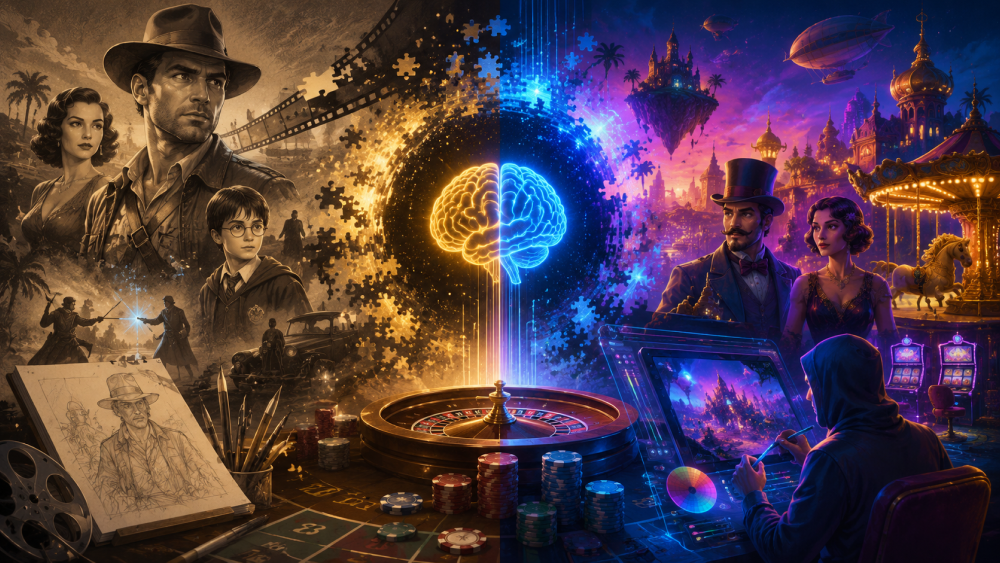
Modern casino sites are mastering a peculiar art: making players feel like they have stepped into a favourite film without ever touching the film itself. The toolkit is generative AI and Creative Commons licensing, and the rules are stranger than most people assume.
Dressed Like the Movies, Owned by Nobody
Walk through a row of new online casinos and a strange pattern emerges. One looks unmistakably like a heist film. Another carries the neon humidity of a cyberpunk thriller. A third drops you into a tropical detective story complete with Hawaiian shirts, a wisecracking lead, and an inexplicable monkey perched on his shoulder. None of them name the film they are evoking. None of them feature an actor whose face you could pin down. And, crucially, none of them are being sued.
This is the new front line of casino theming, and it has been quietly reshaped over the past two years by two unrelated technologies meeting in the same room. The first is generative AI, which has collapsed the cost of producing thousands of bespoke character illustrations from a five-figure commission into something close to free. The second is the maturation of Creative Commons licensing, which now covers everything from photographic backgrounds to vector ornaments to entire typeface families that a designer can drop into a layout without a single email to a licensing department. Together they have given operators a way to dress a site in the costume of a beloved film while leaving the film itself untouched.
Why the law allows this, and where it stops
The legal grammar that makes all of this possible is older than the internet. Copyright in most jurisdictions protects a specific expression, not the underlying idea. A studio owns the precise drawings, footage, scripts, and named characters of its film. It does not own the concept of a goofy detective with a tropical wardrobe, or of jungle adventure as a visual register, or of a man having a comic rapport with a small primate. Those belong to the cultural commons in the same way the figure of the hard-boiled noir investigator does, or the wisecracking space smuggler, or the haunted Victorian aristocrat. They are tropes, and tropes cannot be owned.
Trademark sits alongside this and protects something different: the names, logos, and distinctive brand signals that identify a commercial product. So a casino cannot call itself by the exact title of a film franchise, cannot use the studio's wordmark, and cannot put an obvious likeness of a working actor on the homepage without consent. But it can adopt a single thematic word that exists in the film, render an entirely new character with a thematic resemblance, and lean hard into the colour palette, the wardrobe codes, and the comedic posture that made the source material recognisable.
This is the territory between homage and infringement, and it has always existed. What is new is the speed with which a small team can now occupy it.
Shikaka, and the anatomy of a well-built evocation
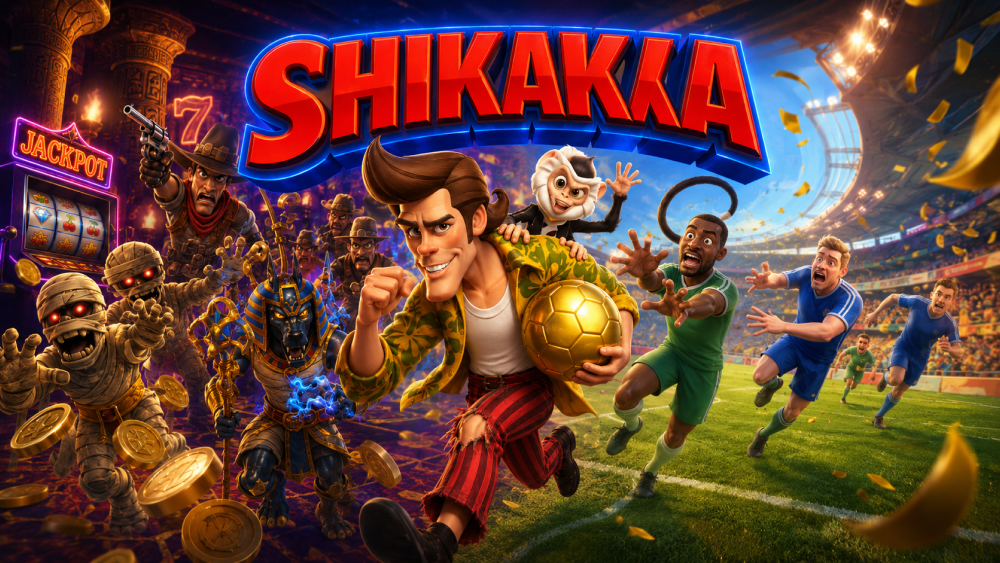
The clearest case study in the wild right now is Shikaka Casino. Anyone who has seen Ace Ventura: When Nature Calls will recognise the word immediately. It is the name of the sacred white bat at the centre of that film's plot, shouted by Jim Carrey across half the second act. The casino takes the word as its brand and builds an entire visual world around the feeling of the film, and yet a careful look at the site reveals that almost nothing on it is legally tied to the movie at all.
The mascot is a man in a loud shirt with a hairstyle that suggests rather than copies the Carrey original, and beside him sits a small monkey. Neither figure is Ace Ventura. The face is plainly generated, the proportions slightly stylised, the wardrobe shifted just enough that nobody could mistake the illustration for a screen capture or a licensed character render. The monkey is a monkey, and monkeys are not copyrightable. The jungle backgrounds are AI-generated landscapes that borrow from a tradition of pulp adventure art going back to the nineteen thirties. The fonts are open-licensed display faces with a tropical flourish. The accent colours sit in the same family the film used, but colour palettes have never been ownable.
What the site achieves is a vibe transplant. A player who grew up watching the film feels an immediate, almost subconscious recognition, and that recognition is doing the marketing work that an actual licence would normally do. The studio behind Ace Ventura has no claim here because nothing on the site belongs to them. The cultural memory belongs to the audience, and the audience brings it with them.
The production stack behind the look
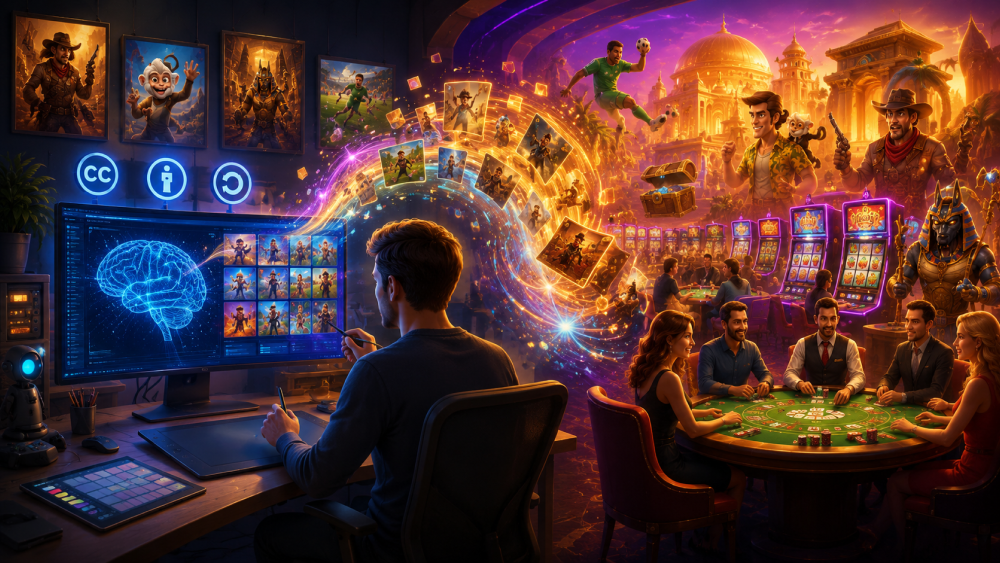
The workflow that produces a site like this has become surprisingly standardised. A small design team will start with mood boarding, but the mood board itself is now usually a folder of AI generations rather than a collection of stills, because using stills as direct reference invites the kind of close mimicry that gets sites into trouble. From there the team generates character concepts in a model that has been fine-tuned or prompted toward a specific aesthetic register, iterating until the figures feel adjacent to the source without resembling any individual actor. The strongest operators document this process and keep prompt logs, because if a challenge ever arrives the paper trail showing independent generation is the difference between a quick legal response and a serious problem.
Backgrounds, ornaments, and ambient assets are then pulled from Creative Commons libraries or generated fresh. The CC layer matters because it is where the unsexy bulk of a site lives — the wood textures, the parchment overlays, the foliage silhouettes, the icon sets — and using properly licensed material here removes any argument that the operator has scraped paid stock or appropriated a designer's portfolio. Attribution, where the licence requires it, ends up in a credits page that almost nobody reads but that exists for the same reason a fire extinguisher exists.
Typography is the last piece and often the most underestimated. A film's title card carries an enormous share of its visual identity, and a casino that picks the wrong display face can either accidentally infringe by using a near-clone of a studio's bespoke type, or undersell the theme by reaching for something generic. The open-source type ecosystem has grown rich enough in the last few years that almost any register a designer wants — pulp adventure, art deco, eighties neon, horror gothic — can be found under a permissive licence.
What separates the careful operators from the reckless ones
The line that gets crossed, when it gets crossed, is almost always a line of literalism. An operator who names a casino after a film outright, who uses an actor's actual face rendered in AI, who lifts a title-card logo with a one-pixel modification and calls it original — these are the cases that end in cease-and-desist letters. The careful operators stay in the realm of evocation. They borrow the genre, the palette, the archetype, and the cultural shorthand, but they invent the specifics. A monkey, yes. That specific monkey from the film, no. A jungle detective, yes. A character whose hair, jacket, and catchphrase replicate a copyrighted performance, no.
There is also a quieter discipline around what the site does not say. Responsible operators in this space avoid claiming any affiliation with the film, do not use phrasing like official or inspired by in the trademark sense, and steer clear of metadata or alt text that names the source work, because search-engine visibility built on a studio's IP is one of the easiest ways to invite scrutiny.
A bigger pattern, beyond casinos
What is happening in casino design is a leading indicator for the rest of the web. The same techniques are being applied to indie game storefronts, to streaming-service landing pages, to niche fashion brands and even to small publishers building book covers that gesture toward a beloved series without infringing it. Casinos got there first partly because the iGaming sector has always been quick to adopt aggressive design tactics, and partly because the economics of player acquisition reward any operator who can make a site feel instantly familiar to a target demographic.
The broader question this raises is whether the cultural commons is being mined responsibly or simply mined. A reasonable defence is that this is what culture has always done. Genre fiction borrows from genre fiction, films quote films, fashion cycles its references every twenty years. The new tools simply lower the barrier so that a four-person studio can do what only a major agency could do a decade ago. A reasonable concern is that when the tools become this cheap, the temptation to drift across the line from evocation into outright imitation grows in proportion. The cases that test where the line really sits are almost certainly already winding their way through courts in the United States, the United Kingdom, and the European Union, and the precedents that emerge over the next few years will reshape this territory again.
For now, the Shikaka model — a single evocative word, an AI-generated cast that resembles nobody in particular, a Creative Commons substrate, and a careful silence about the source — is the playbook. It is legal, it is effective, and it is being copied, ironically enough, faster than anyone can write a brief about it.