
e-Magazine
The Complete Guide to Creative Commons Licences in 2026 — Which One to Choose and Why It Matters More Than You Think
By Mark Levin · May 28, 2026
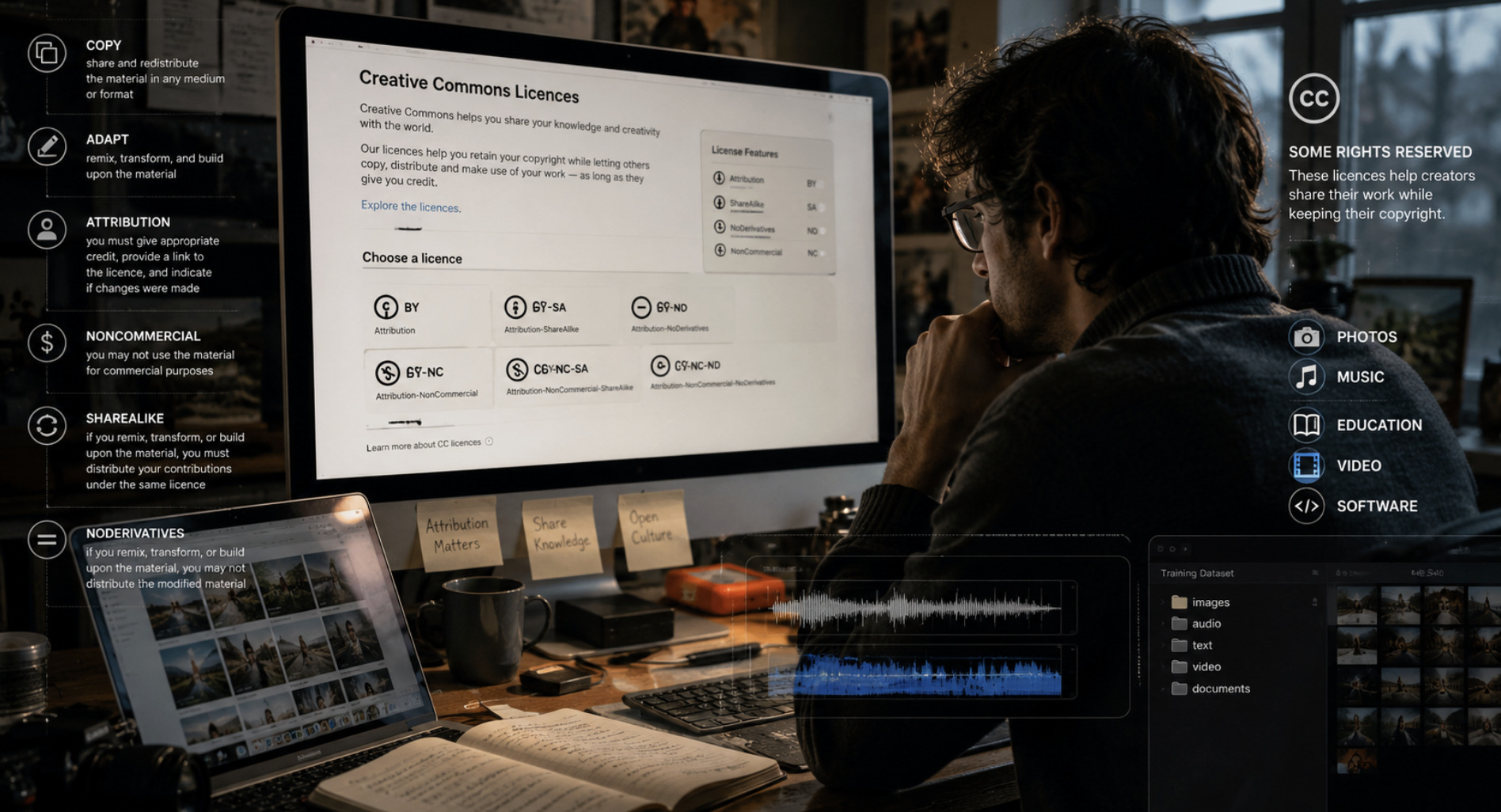
Most people who apply a Creative Commons licence to their work choose it the same way they choose a software end-user agreement — by scrolling to the bottom and clicking accept. They know they want to share their work openly. They know Creative Commons makes that possible. Beyond that, the details seem technical enough that it feels easier to pick something and move on.
This approach produces a lot of mismatched outcomes. Photographers who chose CC BY fifteen years ago and are now discovering their images in AI training datasets. Educators who chose CC BY-NC and cannot understand why their curriculum is appearing on commercial platforms. Musicians who chose CC BY-SA and were surprised to find that a remix released under a different licence is technically in violation of the terms they set.
Understanding what the six CC licences and two public domain tools actually do — and what the difference between them means in practice — is one of the most practically valuable pieces of knowledge a digital creator can have in 2026. This is the guide to all of them.
The Architecture of CC Licences
Creative Commons licences are built from four conditions, which can be combined in different ways to create different licences. Understanding the four conditions makes the entire system legible.
BY (Attribution) — the foundational condition present in all CC licences. Anyone who uses your work must give you credit. The attribution must be appropriate to the medium — in a video, this typically means a caption credit. In a written work, a footnote or citation. On a website, a hyperlink with your name. What counts as "appropriate" varies by context, but the requirement is always present.
SA (ShareAlike) — adaptations must be released under the same or a compatible licence. This is the "copyleft" condition of the Creative Commons system, borrowed from software's GPL licence model. If someone makes a derivative of your ShareAlike work, that derivative must also be ShareAlike. This condition is designed to keep the commons growing — adapted works remain in the commons rather than being enclosed by restrictive terms.
NC (NonCommercial) — use is restricted to non-commercial purposes. This is the most frequently misunderstood condition in the entire CC system. "NonCommercial" does not mean "for free" — it means not primarily intended for or directed toward commercial advantage or monetary compensation. A university using your work in a paid course has generated significant case law and community guidance on whether this constitutes commercial use. An artist selling prints that incorporate your NonCommercial work is almost certainly in violation. The condition sounds clear and its edges are consistently fuzzy.
ND (NoDerivatives) — the work may not be adapted. The work can be shared, republished, and distributed verbatim, but modifications, remixes, and adaptations are not permitted. This is the most restrictive condition available within the CC framework short of full copyright reserved.
The Six Licences, Explained
CC BY is the most permissive licence. It requires only attribution and permits everything else — copying, distribution, modification, commercial use, sublicensing, and incorporation into any other work. If your goal is maximum reach and maximum reuse, CC BY achieves it. Wikipedia content is CC BY-SA. Open access scientific research is typically CC BY. If you want your work to flow as freely as possible into the cultural and knowledge commons, CC BY is the correct choice. The trade-off is that you cannot prevent commercial use, and in the current AI training environment, CC BY works have been among those most freely ingested into training datasets.
CC BY-SA adds the ShareAlike condition. It permits the same broad reuse as CC BY but requires that any adaptations be released under the same or compatible terms. This is the licence that Wikipedia uses, the licence that much open educational resource content uses, and the licence most associated with the copyleft tradition within Creative Commons. If you want your work to remain in the commons even after it is adapted, BY-SA achieves this. The practical consequence is that companies or individuals who want to incorporate your work into proprietary products must either not adapt it or negotiate a separate commercial licence with you.
CC BY-NC combines attribution with the NonCommercial restriction. Commercial use is prohibited; non-commercial use is unrestricted. This licence is popular with individual creators who want their work to circulate freely in educational, personal, and community contexts while reserving commercial rights. It is also the source of more confusion and compliance problems than any other CC licence, because the line between commercial and non-commercial is not self-evident in many real-world contexts.
CC BY-NC-SA adds ShareAlike to the NonCommercial restriction. It is arguably the most restrictive combination within the "permissive" CC family — it restricts both commercial use and requires that adaptations remain under the same terms. Works under this licence remain in a non-commercial commons in perpetuity. For community art projects, activist media, and educational materials where both commercial exclusion and commons continuity are goals, BY-NC-SA is the appropriate tool.
CC BY-ND permits any use, including commercial, but prohibits adaptation. Works can be redistributed verbatim but not modified. This licence is unusual in the CC family because it does not support the remix culture that is central to the CC vision — it is essentially a broad distribution licence rather than a cultural commons licence. It is most commonly used for official documents, statements, and works where the creator wants wide distribution but cannot accept modification — legal documents, institutional reports, and similar materials.
CC BY-NC-ND is the most restrictive CC licence, combining both NonCommercial and NoDerivatives conditions. It permits sharing and redistribution under attribution, but prohibits commercial use and adaptation. It is sometimes described as "free advertising" — it allows your work to circulate but does not allow anyone to do anything commercially useful with it or to build upon it. For creators who want their work visible but tightly controlled, BY-NC-ND serves this purpose. It does not contribute meaningfully to the open culture commons in the way the more permissive licences do.
The Public Domain Tools
Two additional tools are not licences in the legal sense but serve important purposes in the Creative Commons system.
CC0 — pronounced "CC Zero" — is a public domain dedication. A creator who applies CC0 to their work is, to the greatest extent possible under applicable law, waiving all copyright and related rights in the work. CC0 works are as close to public domain as a creator can make them while still being alive and copyright-eligible. For datasets, scientific data, government information, and works where you want to create truly unrestricted access with no licensing conditions whatsoever, CC0 is the correct tool. Major open data projects use CC0. Some national memory institutions have used CC0 for digitised cultural heritage collections.
PDM — Public Domain Mark — is a labelling tool rather than a legal instrument. It is applied to works that are already in the public domain — works for which copyright has expired, or works that were never eligible for copyright protection. A 19th-century photograph that is clearly out of copyright can be labelled with PDM to signal its status to users. PDM does not add any legal rights or restrictions; it provides clear machine-readable information that the work carries no known copyright restrictions.
How to Choose — A Framework for 2026
The licence decision should flow from two questions asked in order.
The first question is commercial use. Do you want to allow commercial use of your work? If yes, your options are CC BY, CC BY-SA, and CC BY-ND. If no, your options are CC BY-NC, CC BY-NC-SA, and CC BY-NC-ND.
The second question is derivatives. Do you want to allow adaptations? If yes, you are choosing between BY and BY-SA (or NC and NC-SA). If no, you are choosing ND. If yes with conditions, you are choosing SA or NC-SA.
The AI training dimension adds a third consideration in 2026 that did not exist when most creators first learned about CC licences. Works released under CC BY are among those most freely usable by AI training pipelines under current legal interpretations. If AI training use is a specific concern — either because you want to prevent it or because you want it to be conditional on compensation — the current licence framework does not resolve this cleanly. This is precisely why Creative Commons has been developing the Signals framework described in other coverage on this platform. Until that framework is available and widely implemented, creators who have specific AI training preferences need to express them through supplementary means — a preference statement on their website, engagement with opt-out mechanisms where they exist, and participation in the policy advocacy work that will shape the legal framework for AI training data.
The Mistake That Changes Everything
The most important practical point about CC licensing is one that many creators discover too late. CC licences are irrevocable. Once you release a work under a CC licence, you cannot revoke that licence for existing uses. You can stop licensing future works under the same terms. You can change the licence you use going forward. But anyone who received a copy of your work under the original licence retains the rights that licence granted, for as long as copyright would otherwise protect the work.
This is not a defect in the system — it is an intentional design choice. The licence is supposed to be reliable. Users who incorporate CC-licensed work into larger projects need to know that the licence will not be revoked when the creator changes their mind or their business model changes. The irrevocability is what makes CC licences trustworthy enough for major institutions to build on.
But it means the initial licence choice matters permanently. The musician who chose CC BY in 2015 cannot revoke that choice for the copies already in circulation. Choose with that permanence in mind.