
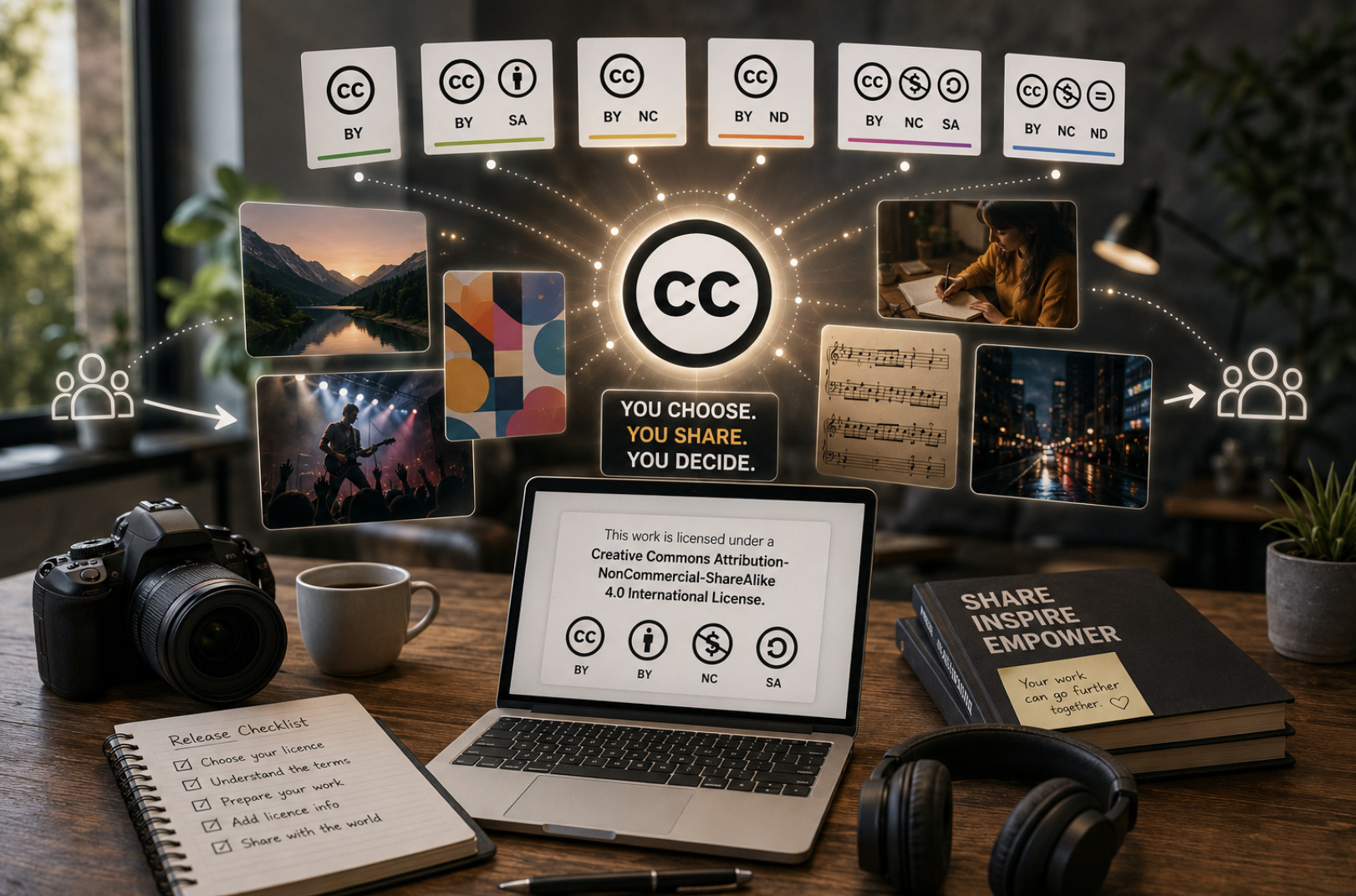
Most conversations about Creative Commons focus on using other people's work. But the whole system exists because creators choose to share their own, and putting your photographs, music, writing or designs under a Creative Commons licence is a deliberate, powerful act: it tells the world exactly how your work may be reused, on your terms, without anyone having to ask. Done thoughtfully, it can spread your work far wider than a locked-down copyright ever would. Done carelessly, it can give away more than you intended, permanently. This guide walks through how to release your own work under Creative Commons the right way, step by step.
Step 1 — Make sure the work is yours to license
Before anything else, confirm that you actually hold the rights to the work. This sounds obvious, but it is the step people skip. You can only license what you own, and if your work includes elements created by others — a photograph containing someone else's artwork, a track sampling another song, a design using a font or image with its own licence — you may not be free to release the whole thing under Creative Commons. You can license your own contribution, but not the parts that belong to someone else.
So the first task is to audit the work honestly. If it is entirely your own creation, you are free to proceed. If it incorporates material from others, you need to be sure you have the right to license that material too, or you must limit your Creative Commons release to the parts you genuinely own. Getting this wrong does not just create a legal risk; it misleads the people who trust your licence and reuse your work in good faith.
Step 2 — Choose the right licence
Creative Commons is not a single licence but a family of them, and choosing correctly is the most important decision you will make. The licences are built from a few conditions you can combine, and each pushes your work toward more or less openness:
Attribution (BY) — the baseline of almost every CC licence: others may use your work as long as they credit you.
ShareAlike (SA) — anyone who builds on your work must release their version under the same licence.
NonCommercial (NC) — others may use your work, but not for commercial purposes.
NoDerivatives (ND) — others may share your work but may not alter or build upon it.
At the most open end sits CC0, which places a work as close to the public domain as possible, waiving essentially all rights. At the more restrictive end are combinations like BY-NC-ND, which allow sharing but little else. The right choice depends entirely on your goal: maximum spread and reuse points toward the most permissive options, while retaining control over commercial use or alterations points toward the more restrictive ones. There is no universally correct licence — only the one that matches what you actually want to happen to your work, a decision that becomes clear once you understand what each option means, as our guide to Creative Commons licences explained sets out.
Step 3 — Understand that it is (mostly) permanent
Before you apply anything, absorb the single most important fact about Creative Commons: the licences are, for practical purposes, irrevocable. Once you release a work under a CC licence and someone uses it under those terms, you cannot retroactively take that permission back. You may stop offering the work under the licence in future and remove it from your own site, but anyone who obtained it while it was licensed keeps the rights the licence granted them, permanently.
This is a feature, not a flaw — it is exactly what makes Creative Commons trustworthy, because people can build on your work without fear that the rug will be pulled out later. But it means the decision to release deserves real thought. Release something under a permissive licence and later wish you had not, and there is no undo button for the copies already in the world. Choose deliberately, as if the choice is final, because in the ways that matter it is.
Step 4 — Apply the licence correctly
Choosing a licence means nothing if you do not clearly communicate it, so the final practical step is to mark your work properly. The goal is to leave no doubt about what you are offering. State clearly which specific Creative Commons licence applies, ideally naming it and its version, and link to the full licence text so anyone can read the exact terms. Place this information where users will actually see it — near the work itself, in a caption, a description, a page footer, or the metadata — rather than buried where it will be missed.
Clarity here protects everyone. A well-marked work tells reusers exactly what they may do and how to credit you, which makes them far more likely to use it correctly and give you proper attribution. A vaguely or incompletely marked work invites confusion, misuse, and disputes. It also helps to specify how you would like to be credited, since attribution is required by almost every licence and making it easy increases the chance it is done right. The clearer your licence statement, the more smoothly your work travels.
A generous act, done with care
Releasing your work under Creative Commons is, at its heart, an act of generosity — a decision to let your creation live beyond you and be built upon by others. It can extend your reach, contribute to a shared commons of usable culture, and connect your work to people it would never otherwise have touched. That is a genuinely worthwhile thing to do, and the system is designed to make it simple.
The care lies in doing it deliberately: licensing only what is yours, choosing the licence that truly matches your intentions, understanding that the grant is essentially permanent, and marking the work clearly so others can honour your terms. Handle those four things well and Creative Commons becomes exactly what it was meant to be — a way to share your work widely and freely while keeping the control you actually care about. Give thought to the choice, then give your work to the world with confidence.
Frequently asked questions
Can I change my mind after releasing work under Creative Commons? Not for copies already in use. CC licences are effectively irrevocable: you can stop offering the work under the licence going forward, but anyone who obtained it while it was licensed keeps the rights it granted them permanently. Choose deliberately.
Which Creative Commons licence should I choose? It depends on your goal. For maximum reuse, a permissive licence like CC BY or CC0 is best. To keep control over commercial use or alterations, add NonCommercial or NoDerivatives. There is no single right answer — only the licence that matches what you want done with your work.
Can I license work that contains other people's material? Only the parts you own. If your work includes photographs, music, fonts or images created by others, you cannot release those parts under Creative Commons unless you have the right to do so. Confirm you hold the rights, or limit your licence to your own contribution.