
e-Magazine
How Audio Storytelling Is Giving Young Voices a New Kind of Confidence
By Anna Vetrova · May 15, 2026
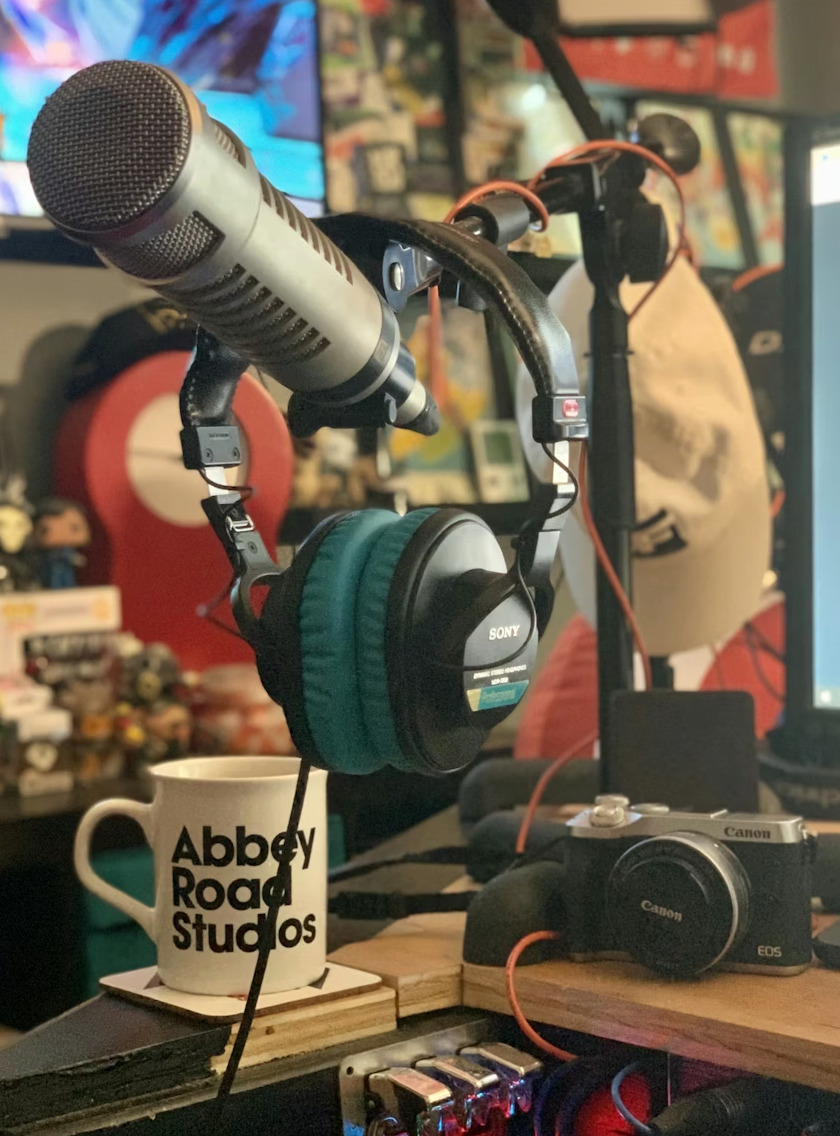
There is a moment that happens consistently in our audio workshops at One Pen One Page and it is the moment that converts most sceptical participants into believers in the form. A young writer reads a piece they wrote for the page, in the recording booth, and listens back to the playback. They almost always say a version of the same thing. I sound different than I thought I did. The piece is different than it was on the page.
That moment, repeated across dozens of workshops over the past three years, is what audio storytelling does that written work alone cannot. It returns the writer to their own voice as a physical fact. For a generation of young writers who have grown up writing primarily on screens, that physical fact is often a surprise. For many of them, it becomes the first time they hear themselves as a public author rather than as a private one.
This is the case for treating audio as a serious extension of the youth writing program, not as a novelty side activity.
What audio teaches that writing alone does not
A page is a forgiving surface. You can revise, delete, redraft, smooth out the rough edges. A piece of writing on the page can hide many of the small dishonesties a writer is tempted to slip in. Audio is less forgiving. The microphone records the breath, the hesitation, the place where the writer is uncertain about the sentence they are reading. Young writers who record their own work develop a different relationship with the truth of their own writing, because the medium will not let them pretend.
The second thing audio teaches is pacing. Reading a personal essay aloud is one of the most reliable ways to discover where the writing slows down, speeds up, or fails to track. Young writers who read into a microphone in week six of a workshop cycle almost always come back to the page in week seven with cuts and rewrites that they could not see when they were silently reading the draft on a screen.
The third is audience awareness. The act of recording a piece for someone else to hear changes the writer's sense of who they are writing for. A piece written for the page is, in many cases, written for an abstract reader. A piece written to be heard is written for a specific listener, and the difference is visible in the final draft.
How our audio workshop runs
The One Pen One Page audio workshop runs in 8-week cycles, alongside the longer writing workshops. Participants typically come in already having a piece of written work they are revising, and they spend the audio cycle producing a recorded version of that piece plus one or two short audio essays produced specifically for the medium.
The technology is intentionally modest. Each session uses USB condenser microphones, a quiet room, free audio editing software such as Audacity or the GarageBand built into Mac systems, and headphones. The goal is not to produce broadcast-grade audio. The goal is to produce honest audio. Young writers leave the cycle with a sense that they can record, edit and publish their own work without depending on professional infrastructure they do not have access to.
The audio engineer who leads the cycle is typically a working professional radio or podcast community who has agreed to mentor for a season. The mentor-to-writer ratio is held at one to four, which is the same ratio as the writing workshops, and for the same reason.
What young writers are recording in 2026
The genres vary across cohorts. Personal essays read by the writer themselves remain the most common. Short fiction, particularly first-person narrative, translates well to audio when the writer has internalised the pacing principles the workshop teaches. Poetry, especially work that uses repetition or internal rhyme, often comes alive in audio in ways the page cannot quite capture.
A category that has emerged more strongly in 2026 is the audio interview. Young writers conduct short interviews with family members, neighbours, community elders or peers, then edit the recordings into 5 to 10 minute pieces with their own framing. These pieces have become some of the most listened-to in the program's public archive. They function as both writing practice and as community documentation, and the side effect is a small but growing oral history collection that may, in time, become one of the most durable outputs of the entire program.
Why this matters for college and beyond
A young writer who can record and publish their own audio in 2026 has a portable skill set that the labour market increasingly rewards. The skills are not just for podcasting careers, although podcasting remains a serious creative industry. They are foundational to journalism, education, marketing, public health communication, and any role that requires the production of clear, listenable, public-facing audio. College admissions readers, in our experience, increasingly notice when an applicant arrives with an audio portfolio that goes beyond the written work.
There is also a more personal benefit. Young writers who hear their own voices played back over and over, in a structured environment with supportive feedback, develop a kind of public confidence that the page alone rarely produces. They learn that their voice is something the world is willing to listen to. They learn this not as theory but as direct evidence.
How parents and educators can support audio work
The most practical thing an adult can do is to make space for recording at home. A quiet corner, even temporarily, is enough. A USB microphone in the under-$80 range is, in 2026, more than enough for the kind of work the workshop teaches. Apple devices come with usable audio editing built in. The technical floor is genuinely low.
The second most practical thing is to listen seriously. When a young writer plays you a finished audio piece, listen the way you would listen to a professional podcast. Take notes. Ask thoughtful questions. The act of being listened to with care, by an adult outside the writer's family, is one of the most consequential parts of the workshop. The same is true at home.
The third is to share the work within reason. The published audio pieces from the program are available on the One Pen One Page website and through the program's podcast feed. Listening together as a family, or in a classroom, is one of the most direct ways to communicate to young writers that their voices matter.
The audio workshop is not the most visible part of the One Pen One Page program. It is becoming, by every internal measure, one of the most consequential. The page taught the writer to construct. The microphone teaches the writer to be heard.